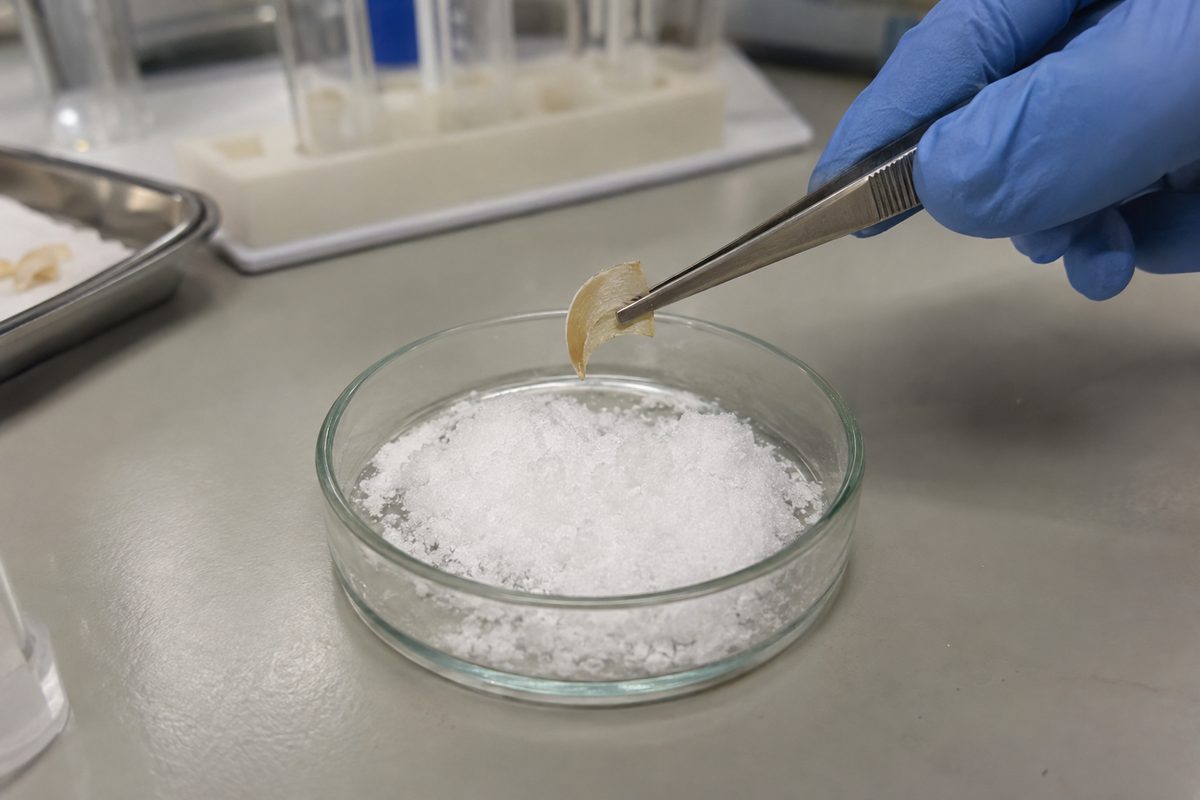
Ask around and somebody's grandmother had a cure for toenail fungus. Pee on your feet in the shower.
It sounds like an old wives' tale. It is still passed around online.
It turns out grandma was onto something. She just didn't have the whole answer.
The ingredient in the old cure
Urine contains urea. Urea is one of the most studied ingredients in nail care. Doctors use it to soften thick, hard nails.
A toenail is made of keratin, the same protein as hair. In a toenail, that keratin is packed into a hard sheet built to keep liquids out.
Urea loosens the bonds that hold that sheet together. In lab tests on hoof, the stand-in researchers use for nail, the more urea they added, the softer the nail got.
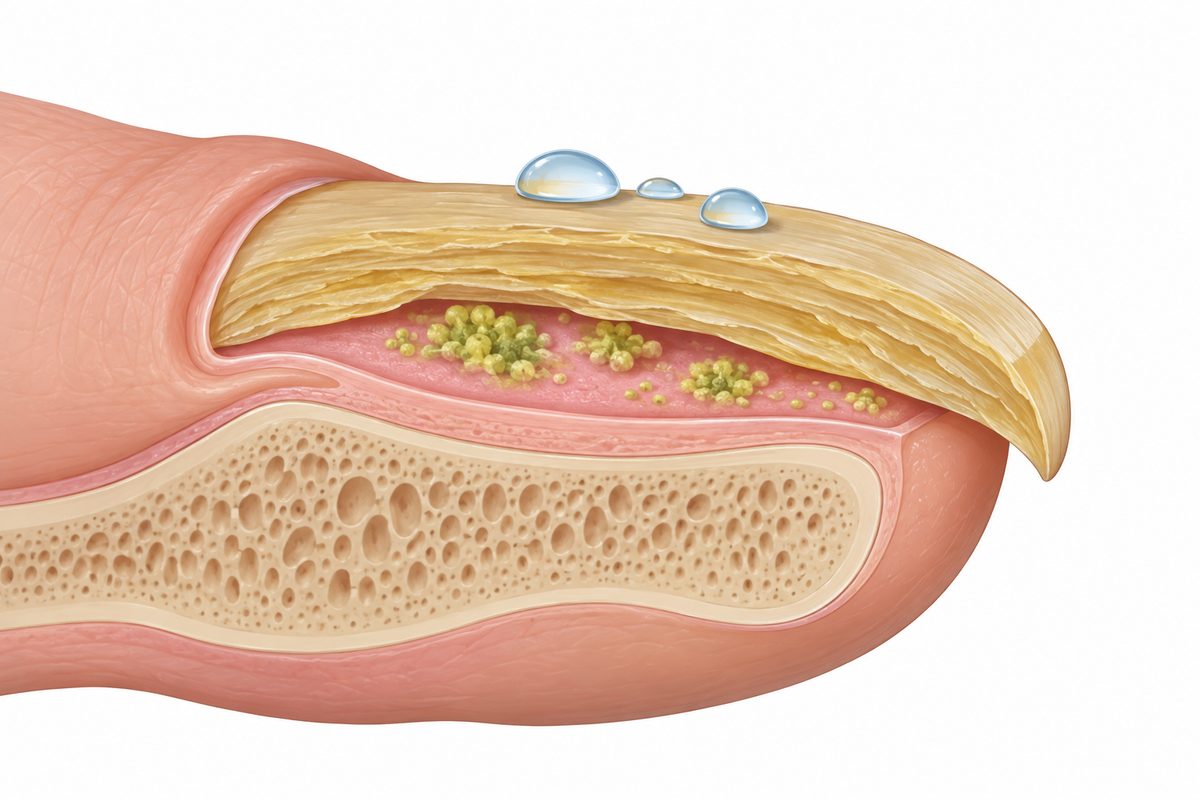
So grandma was half right. The urea part was real.
Why the old cure never worked
There were two problems.
First, there isn't much urea in urine. The nail creams doctors use carry many times more. A splash in the shower was never going to soften a thick toenail.
Second, softening alone doesn't kill anything. The fungus lives underneath the nail, in the nail bed. A softer nail still has the fungus under it.
The drugstore has the same problem in a cleaner bottle. Some nail creams soften the nail and stop there. The nail looks better for a while. Then the fungus comes back.
What the studies found when softening came first
Softening the nail is not a new idea. Researchers have been testing it for decades.
In 1989, researchers Faergemann and Swanbeck gave 23 people with nail fungus a solution of urea, lactic acid and propylene glycol. They put it on twice a day for up to six months. 21 of the 23 improved.
A larger trial later tested a solution with the same three ingredients on 493 patients for 24 weeks. More than twice as many cleared the fungus on the solution as on a placebo: 27.2% against 10.4%.
In a 1998 trial, a cream that paired 20% urea with an antifungal cured 88% of the patients who used it for 16 weeks. On the placebo, none were cured.
None of these studies tested NailScience. They tested the steps. Soften the nail, and the antifungal can finally reach the fungus.
Want both steps in one kit?
Pen one softens the nail. Pen two treats underneath.
Show Me the 2-Step KitTakes 30 seconds → 30-Day Money-Back GuaranteeThe two-step fix, at home
Clinics treat thick fungal nails in the same order: soften the nail first, then treat underneath. NailScience puts both steps into two pens.
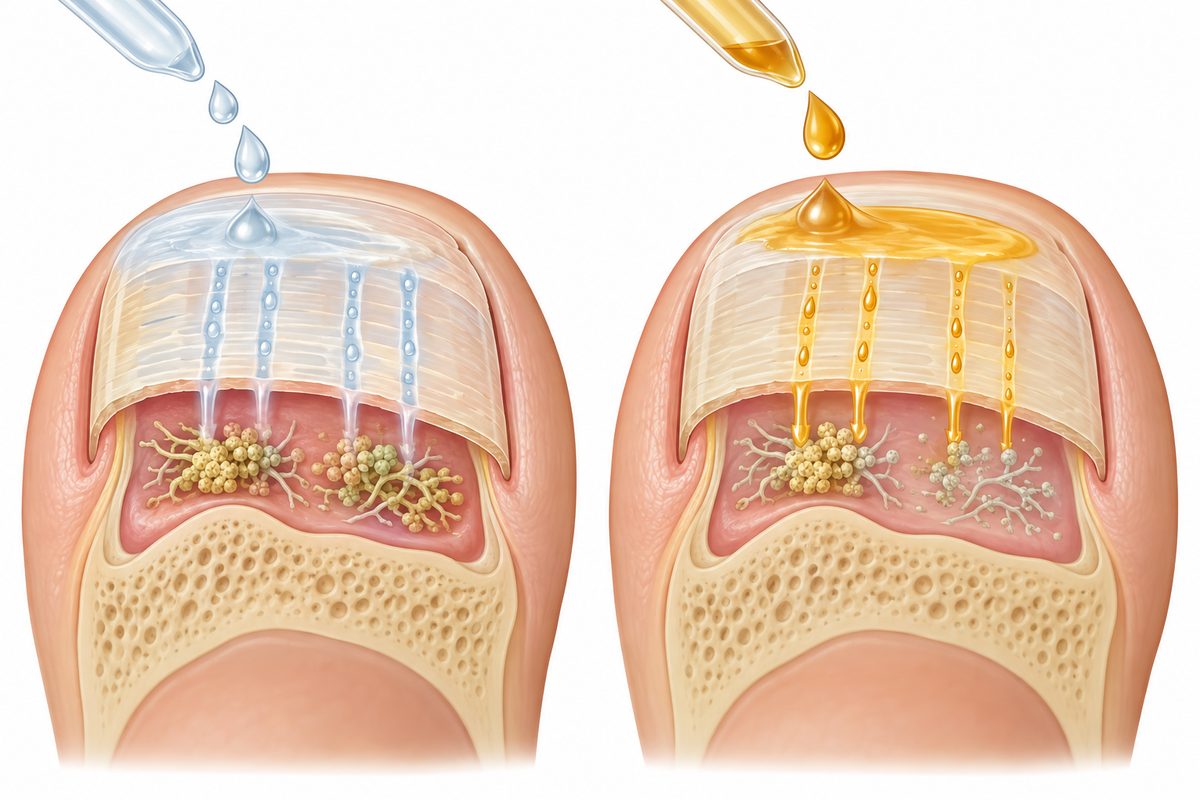
Pen one is the softening step. It uses urea, lactic acid and propylene glycol, the same three ingredients from the studies. It thins the hard nail and opens tiny channels into it.
Pen two is the treatment. It uses 25% undecylenic acid, the strongest antifungal you can buy without a prescription. Tea tree, oregano, manuka and clove oils go with it.
It goes down the channels pen one opened, to the fungus underneath. Each pen takes sixty seconds, twice a day.
What to expect
- Weeks 2 to 4: the nail feels softer and the yellow starts to fade.
- Weeks 6 to 8: a band of clear new nail shows at the base.
- Month 3: the nail is clear.
There are no pills and no blood tests. Nothing goes into your bloodstream.
Grandma had the first step. Now you can have both, without the shower.
Ready to try both steps?
The 2-step kit that softens first, then treats underneath.
Get the 2-Step Kit30-Day Money-Back Guarantee → Send it back even if the pens are emptyStudies cited
- Faergemann and Swanbeck, 1989. A urea, lactic acid and propylene glycol solution for nail fungus, twice daily for up to six months. 21 of 23 patients improved: 2 complete cures, 11 marked improvements.
- A multicenter double-blind trial of a urea, lactic acid and propylene glycol solution: 493 patients, 24 weeks, mycological cure 27.2% against 10.4% on placebo.
- Syed et al., 1998. 20% urea with 2% butenafine cream for great-toenail fungus, 60 patients, double-blind, 16 weeks: 88% cured against 0% on placebo.
- Texture-analyzer studies on bovine hoof membrane, the accepted lab model for nail: the higher the urea, the less force it took to puncture.
These studies tested the ingredients and the steps, not NailScience itself.